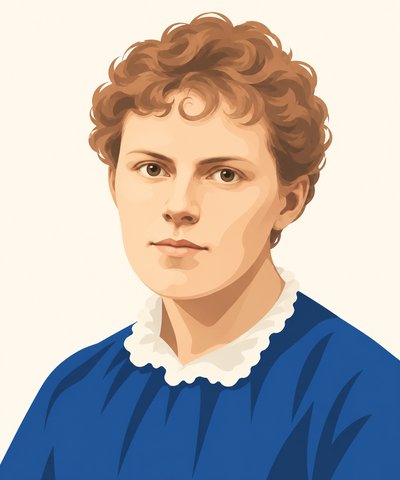
Amy Horrocks was born in 1867 in southern Brazil, where her English parents were living at the time. As a small child she was sent to school in the north of England. When she was 12, the family moved to London. At 15 she entered the Royal Academy of Music in London, where she studied the piano and composition. She won several prizes there. Another student at the Academy was Henry Wood, two years younger, who later became famous as the conductor of the Proms, the big summer concerts in London. In 1897, when she was 29, Wood conducted the first performance of her piece for orchestra, Undine. The audience called her up to the stage twice.
Her most famous song was The Bird and the Rose. The words were by Robert Hichens, a young poet who later became a best-selling novelist. Many years later Hichens wrote in a book about his life that he had been in love with the young musician who set these words to music. The two of them paid for the printing themselves and agreed to share the money. Hichens remembered that the song sold well for many years, and that they both made some money from it.
In 1903, at 36, she married Nico Paramythioti, a Greek businessman, and they made their home in Paris. They had two children. It is said that from the time they were engaged, they wrote to each other every day. After her marriage she composed less. She wrote that she could not concentrate on composing, and that it brought in very little money. In 1919 a Paris newspaper held a competition for a song for peace, after the First World War. She wrote Le Drapeau bleu (The Blue Flag) for it, and it is said to have won the prize. She died in Paris in December 1919, at 52.
Horrocks is remembered above all for one song. For about twenty years, The Bird and the Rose was sung at concerts all over Britain. It was also printed in America, and in 1917 a famous bass singer from the Metropolitan Opera in New York recorded it.
演唱 Amy Horrocks 的曲目
这些曲目收录在 Singalong Solfege 中。可以跟随引导人声和钢琴伴奏,用唱名演唱。
| 编号 | 难度 | 曲名 | 年份 | |
|---|---|---|---|---|
| Ex. 2-18 | ③ | The Bird and the Rose | 1894 |