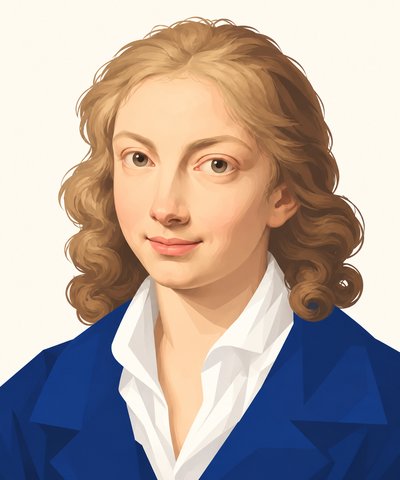
Based on a possible portrait of Vivaldi by Giuseppe Nogari, first half of the 18th century
Antonio Vivaldi was born on 4 March 1678 in Venice. He was so weak that people feared he would not live, so he was baptised at home the same day. His father had first worked as a barber, and later he became a violinist at St Mark’s Basilica, the great church of Venice. Father and son both had red hair. His father was his first teacher, and they often played the violin together around Venice. From birth Antonio had a weak chest, and it was often hard for him to breathe.
In 1693, at 15, he began to study to become a priest. For a boy from a family without much money, the Church gave him a chance of a better life. In 1703, at 25, he became a priest. Because of his red hair, people called him “the Red Priest.” But he led the church service for only about a year. He later wrote that three times he had had to stop in the middle of the service and leave, because of his chest.
In the same year he began to teach the violin at the Ospedale della Pietà in Venice. It was a home for children whose parents could not keep them. In its outside wall there was a small opening where a baby could be left. The girls of the Pietà were trained as musicians, and their orchestra became famous across Europe. When they played in the church, they sat behind a metal screen, so visitors could hear them but not see them. Vivaldi wrote many concertos for them.
Every year the leaders of the Pietà voted on whether to keep each teacher. In 1709 they voted seven to six against him, and he lost his job. In 1711 a book of his concertos was printed in Amsterdam, and his music became known all over Europe. In the same year the Pietà called him back, and this time every leader voted for him. The book also reached Germany. There Johann Sebastian Bach, who was seven years younger, rewrote several of the concertos for the harpsichord and the organ. The two men never met, but studying these concertos changed Bach’s own music.
In his thirties Vivaldi also began to write operas, and from 1714 he ran a theatre in Venice with his father. Until his father died in 1736, the two worked together in the theatre. His father also copied out Antonio’s music by hand. In 1715 a German traveller heard Vivaldi play there. He wrote in his diary that the violin solo was so wild that it frightened him. Vivaldi played such high notes that his fingers almost touched the bow. The traveller then asked Vivaldi to write some concertos for him. According to the diary, three days later Vivaldi brought him ten.
In 1716, at 38, the Pietà made him head of all the music there. The best violinist among the girls had been left at the Pietà as a baby. Vivaldi wrote many of his concertos for her. A poet wrote that when she played, angels came close to listen. For the best singers, Vivaldi wrote sacred songs such as Nulla in mundo pax sincera (In This World There Is No True Peace).
In 1725, at 47, another book of his concertos was printed in Amsterdam. Its first four concertos are The Four Seasons. Each one comes with a poem, and the music follows it. In Spring there are birds, a storm and a shepherd asleep with his dog, and the violas play the barking of the dog. It is said that King Louis XV of France liked Spring so much that he had it played at his court.
Vivaldi was always proud of his speed. In 1739 a French traveller heard him say that he could write a whole concerto faster than another person could copy it out by hand. But the traveller also saw that Venice no longer valued Vivaldi as much as he deserved, because his music was out of fashion.
In 1740, at 62, he sold many of his scores for little money, and he left Venice for good. He went to Vienna, because he hoped that the Emperor Charles VI would help him. Years before, the Emperor had made him a knight, and a writer said that the Emperor talked with Vivaldi more in two weeks than with his ministers in two years. But in October 1740, soon after Vivaldi arrived, the Emperor died. The theatres were closed for a long time, so Vivaldi had no work and no income. His chest had been weak all his life, and for many years walking had been so hard for him that he went out only by gondola or by carriage. He died in Vienna in July 1741, at 63, less than a year after he had arrived.
After his death his music was almost forgotten. In 1926 a large collection of scores in his own hand was found at a school in northern Italy. In 1939 an Italian composer conducted Vivaldi’s Stabat Mater, a song about Mary standing in sorrow by the cross of her son Jesus. Nobody had heard it for more than two hundred years. From then on, more and more people came to love Vivaldi’s music.
Vivaldi was a man full of energy. He wrote music very fast, and he was proud of it. His chest was weak all his life, but he never let it stop him. He wrote about 500 concertos, as well as many operas and much church music. In his lifetime he made an orchestra of orphan girls famous across Europe. His bright, energetic concertos helped to give the concerto its classic shape, in three parts, fast, slow and fast. Bach and composers all over Europe learned from them. Today The Four Seasons is one of the best-known pieces of classical music in the world.
Antonio Vivaldi şarkılarını söyleyin
Bu şarkılar Singalong Solfege'de bulunur. Rehber vokal ve piyano eşliğiyle solfej ile söyleyin.
| No. | Zorluk | Başlık | Yıl | |
|---|---|---|---|---|
| Ex. 8-2 | ③ | Stabat Mater dolorosa | 1712 | |
| Ex. 9-1 | ④ | Nulla in mundo pax sincera | 1716 |