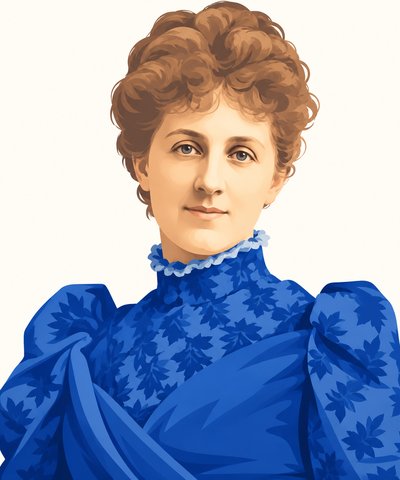
Liza Lehmann was born in London in 1862. Her mother was the composer Amelia Lehmann, and her father was the painter Rudolf Lehmann. Her parents lived in Rome, and after she was born they took her back there. So she spent her first years in Italy, and she spoke Italian before any other language.
As a little girl, when she felt like singing, she ran into the backyard and sang to the chickens. She later called these her first concerts. Her singing moved her relatives. Her aunt was moved most of all, and she often cried when Liza sang. Afterwards she always gave the little girl a piece of jewellery. The piano was different. Her lessons were a misery, and her teacher gave up on her and said she was hopeless. Then a well-known piano teacher heard her play. She thought for a while, and said slowly that she could not call the girl hopeless. She took Liza as a pupil, and Liza later called this “the turning point.”
About 1883, when Liza was about 21, the family spent a winter near Genoa, and Verdi invited them to dinner. So many visitors wanted to sing for Verdi that he kept his piano hidden in his bedroom. After dinner he took them there and showed it to them. He asked Liza to sing. She did not dare to sing his music, so she sang old Scottish songs. Verdi had never heard them, and they interested him greatly.
In 1885, at 23, she sang her first concert in London. She was very nervous before every concert all her life, “but I believe my audiences never knew it,” she wrote. Clara Schumann, who was 43 years older, heard her and invited her to Frankfurt, to learn how to sing Robert Schumann’s songs. For three weeks Clara gave her a lesson every day, and at the end Clara played the piano for her at a party. Over the years Liza began to feel that a singer’s life did not suit her. Then she met the composer and painter Herbert Bedford. In 1894, at 32, she married him, and she gave up singing in public “without a sigh of regret.” They had two sons.
After her marriage she gave her time to composing. In 1896 she wrote In a Persian Garden, for four singers and piano, on an old Persian poem in English. Every publisher refused it, because they thought no one would want music for so many singers. A friend heard it and arranged its first performance in her home in London, with four famous singers and Liza at the piano. Its real success came later, in America, where it was performed at a great many concerts all over the country. Once she played a serious new song for a publisher, and he said that it might be too serious. “I know the sort of thing you want!” she said, and to make fun of him she began to play a light little song. After only a few bars he said quietly, “Yes, that is exactly what I do want!” The song, If I Built a World for You, sold very well for many years, though she herself did not think much of it. In 1908 she set the funny poems from Alice in Wonderland to music. Some musicians thought this was not a proper subject for a serious composer. But she did not think that serious music was better than funny music. If I were a bird, I would sing all day was published in 1910.
In December 1909, at 47, she sailed for a concert tour of America and Canada, where she played the piano while four singers sang her music. She was allowed to bring only two singers from London, so in New York she had to listen to about sixty singers to find the others. For her second tour she insisted on bringing the whole group with her. In Los Angeles she was so tired that she sent a telegram to her manager, saying that she could not go on at that speed. He answered that he was sorry, but he could not make America smaller for her. In 1911 she became the first president of the Society of Women Musicians. She told young composers to take singing lessons, so that they would know what a voice can and cannot do. In 1916 her older son died of an illness at 18, while he was training to be an army officer. After his death she thought that she would never write music again. But her publishers asked her for light, happy songs to help people forget the war. She later wrote that these songs came to her more quickly and easily than any music she had written before. There Are Fairies at the Bottom of Our Garden (1917), from these years, became her best-known song. She died near London in 1918, at 56. She had finished a book about her life two weeks before, and her husband published it the next year.
Liza Lehmann wrote for singers because she had been one. She wrote more than 300 songs, serious and funny, and in her lifetime they were sung all over Britain and America.
Liza Lehmann şarkılarını söyleyin
Bu şarkılar Singalong Solfege'de bulunur. Rehber vokal ve piyano eşliğiyle solfej ile söyleyin.
| No. | Zorluk | Başlık | Yıl | |
|---|---|---|---|---|
| Ex. 4-15 | ② | If I were a bird, I would sing all day. | 1910 |