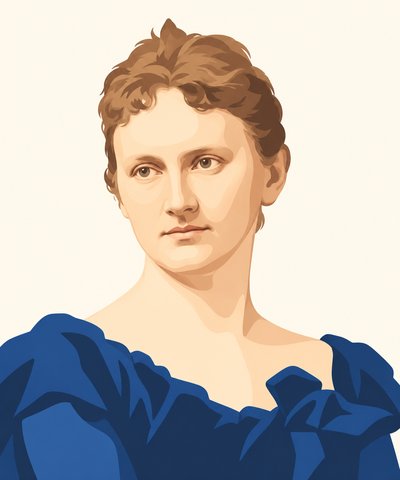
Luise Greger was born Luise Sumpf in 1861 in Greifswald, a small town on Germany’s Baltic coast. When she was born, her father was a cattle dealer, and later he owned a brewery in the town. At five she began to take piano lessons from the town’s music director. At nine she was already writing music of her own, and her earliest surviving songs come from when she was eleven. According to a family story, at nine she was also invited to play at the Russian court in St Petersburg. She wrote a book of 18 songs between the ages of 13 and 16, and it was printed four times in her lifetime.
At about 14 she spent a year in Italy and Switzerland with her mother, who was ill. From then on she loved to travel. It is said that once, at Lake Maggiore in northern Italy, she played the piano every evening for three weeks for Alfred Krupp, the famous German steel maker.
In the 1880s she studied for about a year at the music school in Berlin. At that time women were not allowed to join the class in composition, so she taught herself how to write music. She left Berlin because of her health.
In 1888 she married Ludwig Greger, a doctor, and they had three sons. In 1894 the family moved to Kassel, in central Germany, where her husband opened a sanatorium, a kind of health resort. Luise ran the business side of it. It is said that she could compose only in the early morning and late in the evening. For years few people knew her music. Around 1900 she wrote happily to her sister that she would sing and play at two concerts, “for which I shall also receive a fee.”
In 1911, after 23 years of marriage, she and her husband parted. This was unusual for a woman at that time. She moved into seven rooms in a hotel in Kassel. There she held musical evenings, where she sang her own songs and played the piano herself. Her eldest son, Helmuth, a doctor who was also a trained singer, often sang with her.
The next years brought great sorrow. Her youngest son, Reinhold, was killed in the last days of the First World War in 1918. Her second son, Klaus, had moved to America, and he died there the next year.
Still she went on making music. Between 1912 and 1924 she gave concerts of her songs in many German towns, singing and playing the piano at the same time. In 1924, at 62, she sang her songs to poems by Theodor Storm in Husum, the poet’s home town on the North Sea. The local newspaper praised her beautiful voice. It also wrote that she played the piano from memory, sure of every note.
In 1932 a Kassel newspaper called her “Germany’s most important composer of songs today.” The next year, at 71, she was in the audience when her fairy-tale play Gänseliesel (Goose Girl) was first performed in Baden-Baden. It was given 13 times. Its orchestra parts were later lost, and they were found again only in 2017, in a library in Kassel.
In 1939 Helmuth died too, and she had now lost all three sons. She could no longer pay for her rooms in the hotel, and she moved into a church home for old people near Kassel. She died in 1944, at 82.
After her death her music was forgotten. In the 1990s her great-grandson, the grandson of her son Helmuth, found an old iron chest in his parents’ house. Inside were about 170 of her works and many of her letters. He began to find out everything he could about her life. Since then her songs have been printed again, and they are sung at festivals in Kassel, in Greifswald and even in the United States. According to a Kassel newspaper, her great-great-grandson Antonio Greger is the guitarist of the Kassel band Milky Chance, whose song “Stolen Dance” became a hit all over the world.
Luise Greger ran a business, brought up three sons and still found time to compose. She was brave enough to start a new life on her own at 49, and she was still singing her songs on stage in her sixties. She wrote more than a hundred songs, many of them to poems in Low German, the old language of northern Germany. In her lifetime she was much loved in her own country, and today her songs are being heard again.
Luise Greger şarkılarını söyleyin
Bu şarkılar Singalong Solfege'de bulunur. Rehber vokal ve piyano eşliğiyle solfej ile söyleyin.
| No. | Zorluk | Başlık | Yıl | |
|---|---|---|---|---|
| Ex. 8-19 | ③ | Es duften süß die Linden | 1926 |