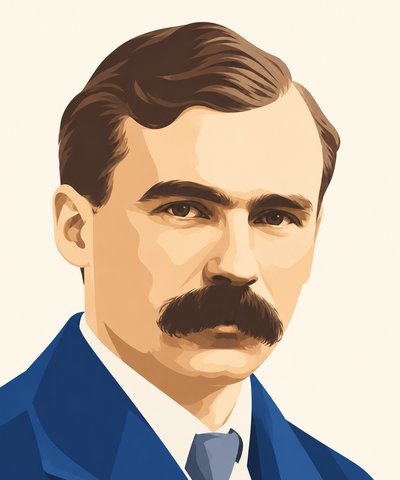
George Butterworth was born in London in 1885, an only child. His father was a lawyer who later ran a big railway company in the north of England, and the family moved to York when George was six. His mother had been a professional singer, and she gave him his first music lessons. At boarding school he played the organ in the chapel and wrote his first pieces, simple hymns. His father kept them in a scrapbook.
At Oxford he studied Latin and Greek, but he spent more time on music. There he met the composer Ralph Vaughan Williams, who was 13 years older, and they became close friends. His father wanted him to become a lawyer. After his mother died in 1911, his father accepted his son’s choice and gave him money to live on.
At that time the old songs of the English countryside were disappearing, because young people in the villages no longer sang them. From 1906 Butterworth went to villages, often with Vaughan Williams, and wrote down songs and dances from old people. Sometimes he recorded them on a phonograph, an early machine that recorded sound. In all he wrote down more than 450 songs and dances. He also learned the morris, an old English dance for groups of men with bells on their legs, and for a time he was paid to show it to the public. He once said, “I’m not a musician, I’m a professional dancer.” A short film of him dancing, made around 1912, still exists.
Butterworth once said to Vaughan Williams, “You know, you ought to write a symphony.” Vaughan Williams had never written one. He wrote A London Symphony, and he later said that he owed its whole idea to Butterworth. In 1911 Butterworth’s own songs on poems from A Shropshire Lad were sung in public, with Butterworth at the piano. The Lads in Their Hundreds is one of them. At one concert the audience asked to hear it again. In 1913 his orchestral piece A Shropshire Lad was played at the big Leeds Festival under one of the most famous conductors in Europe.
He was shy and could seem rough, but his friends said he had a kind heart. A teacher wrote that he was very bad at meeting new people, but very good at keeping his friends. He was very strict with himself and destroyed the pieces he did not like, so only a small number of his works survive.
When the war began in 1914, he joined the army at 29 as an ordinary soldier, together with friends from Oxford. He became an officer in an army unit from Durham, in the north of England, made up largely of coal miners. He never talked about his music, and his commanding officer did not know that he was a well-known composer. He was killed in France on 5 August 1916, at 31. He was given a medal for bravery, and a trench that his men had dug was named “Butterworth Trench.” His father collected his letters and his friends’ memories, and printed them in a book in 1918. Vaughan Williams dedicated A London Symphony to his memory.
Butterworth left only a few works, but they are still played. The more than 450 folk songs and dances that he wrote down helped to save music that would otherwise have been lost.
George Butterworth şarkılarını söyleyin
Bu şarkılar Singalong Solfege'de bulunur. Rehber vokal ve piyano eşliğiyle solfej ile söyleyin.
| No. | Zorluk | Başlık | Yıl | |
|---|---|---|---|---|
| Ex. 13-10 | ⑤ | The Lads in Their Hundreds | 1911 |