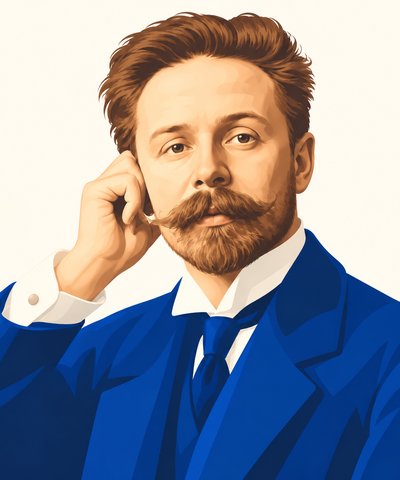
Alexander Scriabin was born in Moscow in 1872, into a noble family. His mother was a concert pianist, and she was still giving concerts two months before he was born. She died of tuberculosis when he was about one year old. His father went abroad as a diplomat, so the boy was raised by his grandmother, his great-aunt and his aunt, who adored him. He was shy with other children and preferred the company of adults. At ten he was sent to a military school in Moscow. He was the smallest and weakest boy there, but he was top of the class, and the other boys came to like him because he played the piano for them. At 16 he entered the Moscow Conservatory.
His hands were small, and he could barely reach a ninth on the keyboard. At 19 he practised two very hard pieces far too much, trying to keep up with a fellow student, and he injured his right hand. A doctor told him he would never play again. For a while he wrote his letters with his left hand. While his right hand was still hurt, he wrote a prelude and a nocturne for the left hand alone. He slowly recovered, and these left-hand pieces were later printed in America and sold thousands of copies. In 1892, at 20, he graduated as a pianist with the second gold medal. The first went to his friend Rachmaninoff, one year younger, who had studied with the same strict piano teacher. At 22 he met Belyayev, a rich timber merchant in St Petersburg who published music, and Belyayev decided to support him. Belyayev paid him a regular income for his compositions and paid for a concert tour of Europe. At 26 Scriabin became a professor of piano at the Moscow Conservatory.
In 1904, at 32, he left Russia and lived for six years in Switzerland, France, Belgium and Italy. There his ideas grew bigger and stranger. He came to believe that music could change the world, and he studied philosophy and Indian religion. In 1908 he met the conductor Koussevitzky, who was also a rich music publisher, and Koussevitzky brought him back to Russia with a generous contract. In 1910 Scriabin and Koussevitzky travelled down the Volga river by steamboat with a whole orchestra, giving concerts in towns that had never heard one. In 1911 his orchestral work Prometheus was performed in Moscow. For Scriabin every key had its own colour. C major, for example, was red to him, and D major was yellow. So in Prometheus he added an instrument that made coloured light instead of sound. As the music moved from one key to another, the light in the hall was supposed to change colour. Nobody had built such an instrument yet, so in Moscow the piece was played without any lights. The first performance with coloured lights took place in New York in 1915, a few weeks before his death, and he was not there. So he never saw his own idea realised. He also dreamed of a final work, the Mysterium. It was to be performed for seven days in a temple in India, with music, dance, perfumes and light, and he believed it would change all of humanity. He wrote only sketches for it.
Scriabin was a small man, a little over five feet tall, nervous and very particular. It is said that he washed his hands after every handshake and took more medicine than any doctor prescribed. Yet his friends found him charming, and in his last years young musicians gathered around him as if he were a prophet. When Vladimir Horowitz, later one of the most famous pianists of the century, was about ten, his uncle brought him to play for Scriabin. Scriabin told the parents that the boy was extremely talented, and that he must also learn about literature and art, not only music. Boris Pasternak, later the author of Doctor Zhivago, spent a summer next door to him as a boy of 13. He adored Scriabin, and because of him he studied composition for six years before he turned to poetry. In April 1915 a small sore on Scriabin's lip became infected, and the infection spread through his body. He died in Moscow at 43. So many people wanted to attend the funeral that tickets had to be printed. That autumn Rachmaninoff toured Russia playing only Scriabin's music, to raise money for the family. It was the first time he had given recitals of another composer's music. As a young man he adored Chopin, and it is said that he slept with Chopin's music under his pillow. Like Chopin, he wrote almost only for the piano: ten sonatas, about ninety preludes and many short pieces. He wrote only six works for orchestra, including one piano concerto. Scriabin's only song is Romance. For a few years before his death he was the composer everyone in Russia talked about, and his late piano music became a model for the new music of the twentieth century.
Пойте произведения: Alexander Scriabin
Эти произведения есть в Singalong Solfege. Пойте их сольфеджио с ведущим голосом и фортепианным аккомпанементом.
| № | Сложность | Название | Год | |
|---|---|---|---|---|
| Ex. 13-8 | ④ | Romance | 1893 |