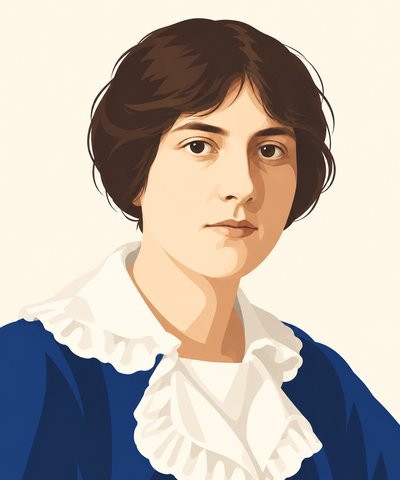
Lili Boulanger was born in Paris in 1893 into a family of musicians. Her father, Ernest, was a composer and a singing teacher at the Paris Conservatoire. He was 77 when she was born. Her mother came from St Petersburg in Russia and had been his singing pupil. Her sister Nadia was six years older. It is said that when Lili was born, Nadia promised to look after the baby. Their father died when Lili was six. At two Lili became very ill with pneumonia, and after that she was never strong. She often could not go to school, so her mother and Nadia taught her at home.
The composer Fauré was a friend of the family. It is said that he found that the two-year-old had perfect pitch, and that later he brought his new songs to the house for her to sing. Lili learned the piano, the violin, the cello and the harp. As a small child she went with Nadia to her classes at the Conservatoire, and she also sat in on Fauré’s composition class.
According to a well-known story, when she was 16 her mother asked her how she would earn her living. Lili answered at once that she would study composition and win the Prix de Rome. This was the most important prize for young French composers, and no woman had ever won it. Nadia had tried four times and had won only second prize. Reflets (Reflections) was written in 1911, when Lili was 17. In 1913, at 19, Lili tried again after an illness the year before. The candidates were shut in a palace outside Paris, and they had a month to write a cantata, a long piece for singers and orchestra. Her mother was very worried, because she could not go with Lili to look after her. For the judges, each cantata was performed by singers with a piano. The other candidates, all men, stood beside the performers and beat time with their hands to push them on. Lili stood quietly and did not beat time even once. A music critic who was there wrote about this. She won 31 of the 36 votes, and she became the first woman to win the first prize. After the prize, an Italian music publisher gave her a contract with a yearly income, so that she could live by composing.
In 1914 the First World War began. Lili was too ill to be a nurse. So she began writing to the young musicians from the Conservatoire who were fighting at the front. She sent them letters and parcels, and she helped their families with food and money. The work grew, so she asked Nadia to help. The two sisters made a small newspaper with letters from the soldier musicians, so that friends at the front could hear from each other. She died near Paris in March 1918, at 24.
After Lili’s death, Nadia stopped composing, partly because she believed Lili had been the more gifted. She became the most famous teacher of composition of the century, and for more than 60 years she worked to make Lili’s music known.
Lili Boulanger was often ill, but she was not weak. At 16 she decided to win a prize that no woman had ever won, and at 19 she won it. She wrote songs, music for choir and music for orchestra that are performed all over the world today.
Пойте произведения: Lili Boulanger
Эти произведения есть в Singalong Solfege. Пойте их сольфеджио с ведущим голосом и фортепианным аккомпанементом.
| № | Сложность | Название | Год | |
|---|---|---|---|---|
| Ex. 7-13 | ④ | Reflets | 1911 |