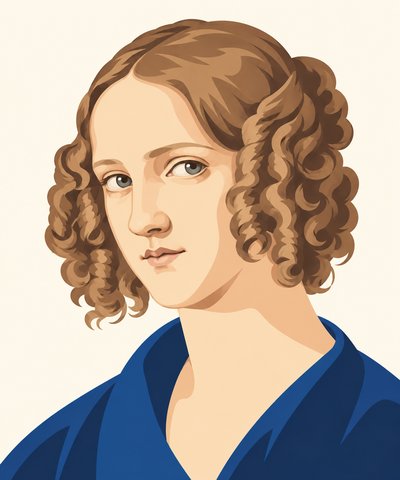
Josephine Lang was born in Munich, in southern Germany, in 1815. Her father played the violin in the court orchestra, and her mother was a well-known singer. She was a small, shy child, and her parents called her their “worry child.” At about five she made up her first song, both the words and the music. Her brother’s music teacher heard her singing it. He laughed at the words, but he wrote the tune down and told her parents to give her piano lessons. Later the best piano teacher in Munich heard her play and offered to teach her for free. At 11 she played in public for the first time. Her mother died when she was 12. Although she was still a child, she began to teach the piano to earn money for her family. On some days she taught as many as eight lessons.
In 1830, when she was 15, she was called into a friend’s drawing room to meet a visitor. It was Mendelssohn, then 21 and already well known. He made her sing her songs again and again. When he came back the next year, he gave her a lesson every day at twelve o’clock. He wrote to his sisters that she had “the gift of composing songs and singing them in a way I never heard before.” He wrote that when she began to sing, everyone in the room became quiet and thoughtful. He wanted her to study in Berlin, with his sister Fanny as her piano teacher, but her father would not let her go. Fanny never met her, but she wrote to her brother that she played Lang’s songs again and again. Later a trip to Vienna for more study was planned. Her trunk was packed and her seat in the coach was paid for, but her father found the goodbye so hard that she gave up the plan. She never left Munich to study.
In 1838, at 23, she went to Salzburg and played for Mozart’s widow, Constanze, who wrote kind words in her album In the same year Robert Schumann printed one of her songs in his music magazine. By then she was a singer in the royal chapel in Munich, and the queen of Bavaria liked her very much. After a serious illness, the queen sent her to a health resort in the mountains. There a young lawyer, Reinhold Köstlin, heard her singing in the next room and asked to meet her. He also wrote poems. Every day he sent her a new one, and the next day she sent it back set to music. In 1842, at 27, they married. They moved to Tübingen, a university town in south-west Germany, where he became a professor of law. They had six children. On their wedding trip on the Rhine, he wrote a poem about a little bird flying above the boat, and she set it to music. More than forty years later, Brahms set the same poem to music.
Abschied (Farewell) is a setting of one of her husband’s poems. Her husband died in 1856, when she was 41, and she was left with six children. She earned money by teaching music, and among her pupils were two young princes. Her old friends helped her. In 1867 the composer Ferdinand Hiller, a friend from Munich, wrote a long newspaper article that asked why so few people knew her songs, and it brought her publishers. Clara Schumann also helped her to find publishers. Lang once said that the melody came to her while she was still reading the poem, and she called her songs her diary. Lang died in Tübingen in 1880, at 65. The next year her son wrote a short book about her life, with a list of all her works and the years in which she wrote them.
Josephine Lang wrote about 300 songs. Mendelssohn, Fanny Hensel and Robert Schumann admired them, and her friends made sure that they were printed.
Пойте произведения: Josephine Lang
Эти произведения есть в Singalong Solfege. Пойте их сольфеджио с ведущим голосом и фортепианным аккомпанементом.
| № | Сложность | Название | Год | |
|---|---|---|---|---|
| Ex. 2-6 | ② | Abschied | 1843 |