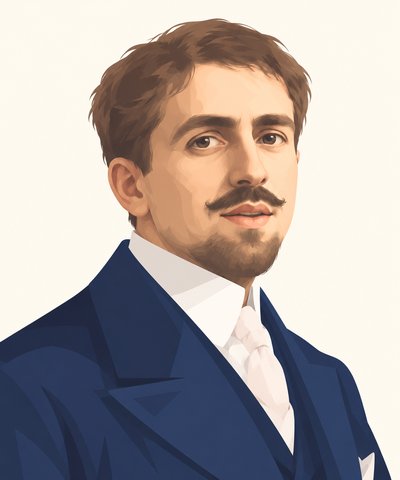
Reynaldo Hahn was born in 1874 in Caracas, Venezuela, the youngest child of a large family. His father, a businessman from a Jewish family in Hamburg, was an adviser on money matters to the president of Venezuela. His mother was Venezuelan, and his first language was Spanish. When he was a small child, the family moved to Paris.
He sang from a very early age. When he was seven, his mother wrote in a letter that Princess Mathilde, a niece of Napoleon, had asked him to sing for twenty guests at her house. At about the same age his parents took him to see the great actress Sarah Bernhardt, and he never forgot it.
In 1885, at 11, he entered the Paris Conservatoire. A classmate remembered that when their piano teacher needed a new piece for the pupils to sight-read, she would say, "Reynaldo, write us something!" Ten minutes later the piece was ready. At about 13 he wrote Si mes vers avaient des ailes, which he dedicated to his sister Maria. It is still his best-known song.
As a teenager he was welcomed at the home of the writer Alphonse Daudet, where he played and sang his songs. Daudet often asked him to play the same song three times in a row, listening with his eyes half closed. Another writer there, Edmond de Goncourt, did not like music, but after hearing Hahn he said, "You will end up making me love music." At 17 he wrote a set of songs to poems by Paul Verlaine, among them L'heure exquise.
Jules Massenet took him as a private pupil, and Hahn loved him like a father. Once, looking at a new song by the young man, Massenet said: "There is not one note to change. What a pity you are not French!" The Prix de Rome, France's top prize for young composers, was open only to French citizens, and Hahn was still Venezuelan. He called it "a cruel sorrow." He became a French citizen many years later, in 1907, at 33.
In 1894, at 19, he met the young writer Marcel Proust at a party where he had come to sing. For about two years they were lovers, and after that they stayed close friends for the rest of Proust's life.
In the 1890s he was the favourite singer of the Paris salons. He sang his own songs at the piano in a light, soft voice, often with a cigarette in his mouth. In his book on singing he wrote that his friends were surprised he could sing like that, and that the cigarette stayed in place because he hardly moved his lips. In 1899 he published a set of twelve songs to old French poems, among them Quand je fus pris au pavillon.
In 1896 he became a close friend of Sarah Bernhardt, the actress he had admired as a boy. He spent summers at her house by the sea. One evening there he played a gipsy song while an old friend of hers danced wildly, and Hahn laughed so hard that he fell off the piano stool and rolled on the floor.
All his life his great model was Mozart. In 1906, at 32, he conducted Mozart's opera Don Giovanni at the Mozart festival in Salzburg, Austria.
When the First World War began in 1914, Hahn was 40 and a famous society musician, but he insisted on going to the front, although Proust tried to stop him. He carried messages by bicycle and worked as an interpreter for a general's staff. At night, in the staff office, he wrote music on his knees. In 1918 he received a medal for bravery. In 1916, during the war, he published À Chloris, a song in the style of the early 18th century.
In 1922 Proust died, and the next spring Sarah Bernhardt died too. Three weeks after her death, in April 1923, his light opera Ciboulette opened in Paris. It was a huge success, and it is still performed in France today.
In 1940, when Germany occupied France, Hahn, as a man of Jewish descent, had to leave Paris. He spent the war years in the south of France and in Monaco. When the war was over, in 1945, he came back, and at 70 he was made director of the Paris Opéra.
In 1946, at 71, he went on a concert tour to London, Geneva and Brussels. Soon afterwards he fell ill. He had an operation, but he did not recover, and a few months later, on 28 January 1947, he died at home in Paris, at 72. He was buried near Proust.
Hahn was a charming, cheerful man who loved friendship, good company and the music of the past. While composers around him, such as Debussy and Ravel, were looking for new sounds, he kept to a simple, older style. His songs have plain, graceful melodies that follow the French words closely. He sang them himself better than anyone, and they made him the favourite of the Paris salons.
Пойте произведения: Reynaldo Hahn
Эти произведения есть в Singalong Solfege. Пойте их сольфеджио с ведущим голосом и фортепианным аккомпанементом.
| № | Сложность | Название | Год | |
|---|---|---|---|---|
| Ex. 5-11 | ② | Si mes vers avaient des ailes | 1888 | |
| Ex. 11-10 | ② | L'Heure exquise | 1892 | |
| Ex. 13-9 | ⑤ | Quand je fus pris au pavillon | 1899 | |
| Ex. 9-13 | ② | À Chloris | 1916 |