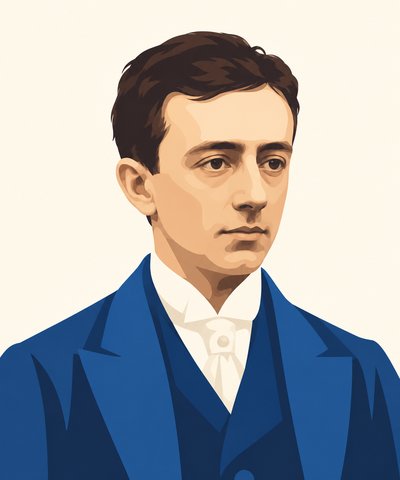
Manuel de Falla was born in 1876 in Cádiz, a port city in the far south of Spain. His father was a merchant, and his mother, a good pianist, gave him his first lessons. His nursemaid sang him the folk songs of Andalusia. He was taught at home and had little contact with other children, and he stayed shy all his life. As a boy he made up an imaginary city and ruled it himself. He later remembered that the city had a big theatre, where his own opera was a great success. He was both the composer and the conductor. At 20 he went to Madrid to study the piano, and at 22 he won the Conservatory's first prize. Soon after, he met Felipe Pedrell, 35 years older, a composer who had spent his life collecting Spanish folk songs. Pedrell told him that Spanish music must grow out of the songs of the Spanish people, and Falla later said that he owed him the clearest and firmest direction of his work. His family had money troubles, so he taught the piano and wrote light musical comedies to earn money. In 1905 his opera La vida breve (The Short Life) won a national prize, and he was promised a production in Madrid. But the opera house there was interested only in Italian operas, and the production never happened.
In 1907, at 30, he moved to Paris with almost no money, and he stayed seven years. At first he earned his living by playing the piano for a group of travelling pantomime actors. Dukas, 11 years older and the composer of The Sorcerer's Apprentice, helped him first. Dukas introduced him to Albéniz, another Spaniard in Paris, who got him a grant from the King of Spain. He also met Debussy, who was 14 years older and already famous, and played him La vida breve on the piano. Debussy liked the opera. But Debussy liked to make sharp jokes, and the shy Falla was a little afraid of him. Ravel, one year older, became a friend, and so did the young Stravinsky, six years younger. In 1914 the First World War began, and Falla went home to Madrid. He had just finished the Seven Spanish Folk Songs. One of them is Asturiana.
Back in Spain, between the ages of 38 and 43, he wrote the works that made him famous. One was the ballet El amor brujo (Love the Magician), which includes the famous Ritual Fire Dance. Another was Nights in the Gardens of Spain, for piano and orchestra. The third was the ballet The Three-Cornered Hat. Diaghilev's Russian Ballet performed it in London in 1919, with sets and costumes by Picasso. Falla was not there. He had been called home because his mother was dying, and she died on the day of the premiere. In 1920, at 43, he settled in Granada, in a small white house below the Alhambra. He never married. His sister María del Carmen lived with him and ran the house for the rest of his life. In Granada he became the friend of a 22-year-old student, Federico García Lorca, who later became Spain's most famous poet. In 1922 the two of them organised a festival in the Alhambra for cante jondo, the "deep song" of the Andalusian gypsies.
Falla was small and thin, shy and modest, and deeply religious. Stravinsky wrote that he had never known anyone so strictly religious, and that Falla had almost no sense of humour. He worried endlessly about his health. He took many medicines and was afraid of cold air coming through open doors and windows. He worked slowly and finished very little. He wanted no money, no honours and no possessions. He wanted only to pray, to write music and to live simply. In August 1936, at the start of the Spanish Civil War, his friend Lorca, the poet, was arrested in Granada. Falla went to the authorities to plead for him, but it was too late. Lorca had already been shot. Falla shut himself up in his house, and his health broke down. The war ended in 1939 with the victory of Franco, whose soldiers had killed Lorca. That autumn, at 62, Falla left for Argentina with his sister, officially just to conduct some concerts. But he never came back to Spain. He died in Argentina in November 1946, nine days before his 70th birthday. His sister brought his body home to Cádiz, where he is buried in the cathedral. He wrote only about twenty works in his whole life, but almost all of them are still played today. He once said that in folk music the spirit matters more than the letter, and most of his music sounds Spanish without copying a single folk tune.
Пойте произведения: Manuel de Falla
Эти произведения есть в Singalong Solfege. Пойте их сольфеджио с ведущим голосом и фортепианным аккомпанементом.
| № | Сложность | Название | Год | |
|---|---|---|---|---|
| Ex. 4-17 | ① | Бесплатно | Asturiana | 1914 |