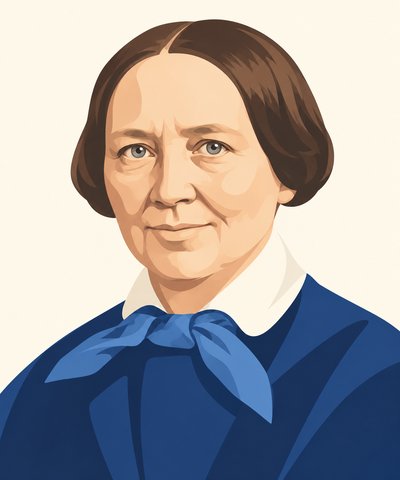
Emilie Zumsteeg was born in Stuttgart, in south-west Germany, in 1796, the youngest of seven children. Her father, Johann Rudolf Zumsteeg, was the head of music at the court there and a school friend of the poet Schiller. He died when Emilie was five. To support the family, her mother opened a music shop, and Emilie later worked in it. When Emilie was a small child, her mother wrote to a music publisher that the girl looked just like her father. “If she were a boy,” she wrote, “she would surely take the place of our good Zumsteeg.”
Emilie studied the piano and harmony with musicians from the court orchestra. She could play a full orchestral score on the piano at first sight. She also sang, with a beautiful low alto voice. At 20 she published her first songs. An meine Zither (To My Zither) was published in 1819, when she was 22.
In 1826 she organised the first performance of Handel’s Messiah in Stuttgart, and she played the piano part. Around 1830 she started one of the first women’s choirs in Germany. As a woman she could not have an official post, so she led the choir without pay. She trained the women singers for big concerts, and a man conducted on the day. In 1841 a newspaper wrote that no man, however great a master, could have done this work better. The city gave her a brooch, and the king gave her a yearly payment.
She never married, and she earned her living by teaching the piano. It is said that she gave half of her lessons free to poor pupils with talent. She died in Stuttgart in 1857, at 60. People from every part of society came to her funeral. At her own wish, she was buried in her mother’s grave.
Emilie Zumsteeg could not become the head of music at court like her father, because she was a woman. So she did the work without the title. After her death a poet wrote that “unbelievably many” people owed to her their knowledge of music and their joy in it.
Chanter les morceaux de Emilie Zumsteeg
Ces morceaux sont dans Singalong Solfege. Chantez-les en solfège avec une voix guide et un accompagnement de piano.
| N° | Difficulté | Titre | Année | |
|---|---|---|---|---|
| Ex. 5-5 | ④ | An meine Zither | 1819 |