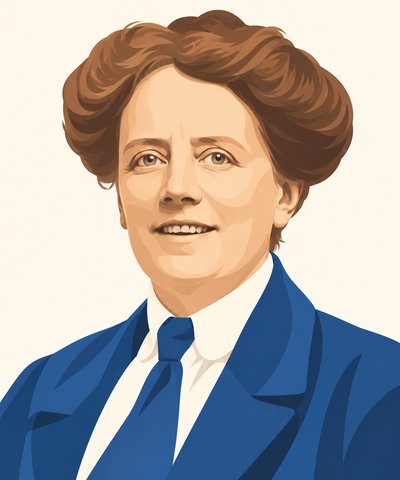
Ethel Smyth was born in England in 1858. Her father was a general in the army. When she was 12, a young woman who had studied music in Leipzig, in Germany, came to teach the children at home. She played classical music to Ethel, and Ethel loved it. She later wrote that she decided then to study in Leipzig one day.
When she was about 17, she told her family that she wanted to study in Leipzig. Her father said no. To him, an artist was a person who did not live a decent life. She later wrote that he shouted that he would rather see her dead. So Ethel decided to make life at home so unpleasant that her parents would have to let her go. She took the train to concerts in London without asking them. The village shopkeepers lent her the money for the tickets, and she told them to send the bill to her father. Then she stopped going to church, and in the end she stopped speaking to anyone. At last her father agreed. In 1877, at 19, she left for Leipzig.
But the Leipzig Conservatory was not what she had dreamed of for seven years. One teacher came 15 minutes late to a 40-minute class, told funny stories, and never looked at her work. Then she showed her exercise books to the composer Heinrich von Herzogenberg. He laughed when he saw that nobody had corrected her mistakes, and he offered to teach her himself. He said it would be fun, because he had never given a lesson in his life. So after about a year she left the Conservatory, but she stayed in Leipzig and studied at his home. His wife, Elisabeth, was one of Brahms’s closest friends. At their home Ethel met Brahms in 1879, when she was 20. He was 25 years older. It is said that Elisabeth once played Brahms a short piece that Ethel had written in the style of Bach. She told him that it was a piece by Bach that had just been found. Brahms believed her. When he learned the truth, he praised Ethel. She also met Clara Schumann, who was 39 years older. Clara said that she liked to hear Ethel play the piano. But she did not like to watch her, because of the way Ethel held her hands.
In 1888, at 29, she met Tchaikovsky in Leipzig. He was 18 years older and already famous. She later wrote that of all the composers she knew, he was the most delightful person. Tchaikovsky also wrote about her. He wrote that she was one of the few women composers who were really achieving something valuable. He told her to study the sound of the orchestra. She took his advice. At concerts she listened carefully to how each instrument sounded, and she wrote down what she heard in notebooks.
In 1891, back in England, she wrote a large Mass, a church work for choir and orchestra. At first no choir would perform it. But Princess Christian, a daughter of Queen Victoria, liked the music and wanted to help. With her help, the Mass was performed at the Royal Albert Hall in London in 1893, when Ethel was 34. From then on people saw her as a serious composer.
After that she wrote operas. In 1903 her opera Der Wald (The Forest) was staged at the Metropolitan Opera in New York, one of the most famous opera houses in the world. For more than a hundred years, until 2016, it was the only opera by a woman ever staged there. In 1909 the English conductor Thomas Beecham conducted her opera The Wreckers in London. He later called her “a born fighter.”
She loved sport, above all golf. In 1910 she moved to a house near Woking, south-west of London, so that she could live near a golf club.
At that time women in Britain could not vote. In 1910, at 52, Ethel joined a group led by Emmeline Pankhurst, which fought for women’s right to vote. That year she wrote “The March of the Women,” and Pankhurst made it the song of the group. Some members broke windows to make the government listen. In 1912 Ethel threw a stone through a window of a government minister’s house. She was sentenced to two months in prison. While she was there, Beecham came to visit her. He found the women in the prison yard, marching and singing her march. Ethel was leaning out of an upper window, and she was conducting them with a toothbrush. She was let out after about three weeks.
In 1913 she wrote Three Moods of the Sea, three songs for voice and orchestra. After Sunset is the third song. Around the same time her hearing began to get worse. As it got worse, she wrote less music, and she began to write books, most of them about her own life. In 1922, at 63, she received the title of Dame from the king. It is the woman’s form of the title “Sir,” and she was the first woman composer to receive it.
She died at her home near Woking in 1944, at 86. As she had wished, her ashes were scattered in the woods near the golf course.
All her life Ethel Smyth fought for what she believed in. At 19 she made her father let her study music, and at 52 she fought for women’s right to vote. Her Mass was performed at the Royal Albert Hall, her opera was staged in New York, and thousands of women sang her march at their meetings.
Chanter les morceaux de Ethel Smyth
Ces morceaux sont dans Singalong Solfege. Chantez-les en solfège avec une voix guide et un accompagnement de piano.
| N° | Difficulté | Titre | Année | |
|---|---|---|---|---|
| Ex. 5-12 | ③ | After Sunset | 1913 |