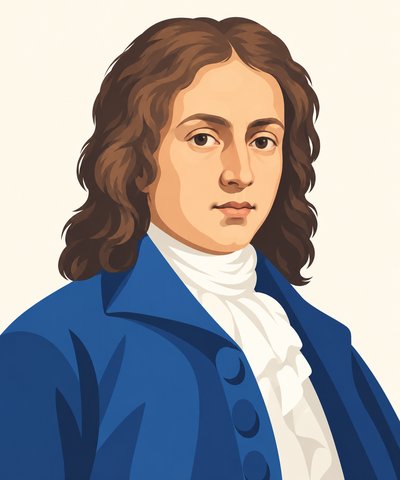
Alessandro Scarlatti was born in 1660 in Palermo, on the island of Sicily, the second of eight children. His father was a musician, and several of his brothers and sisters also became singers and players. In 1672, when he was 12, he was sent to Rome, probably because of a famine in Sicily. His father died while Alessandro was still young. In 1678, at 17, he married Antonia Anzalone. They had ten children. Two of their sons became composers, and one of them, Domenico, later became famous for his harpsichord music.
In 1679, at 18, he wrote his first opera in Rome, and it was a great success. So many people pushed at the theatre doors that the guards began to fight. Queen Christina of Sweden had given up her crown and lived in Rome, and she loved music. She made the young composer the director of her music. His sister had secretly married a priest, and some Church leaders in Rome were angry with the family. But the queen sent her own carriage to bring him to the theatre, so that he could play in the orchestra.
In 1684, at 23, he became the head of music at the court in Naples, a city then ruled by the King of Spain. He stayed there for 18 years and wrote at least two operas every year. Le Violette (The Violets) comes from one of them, Pirro e Demetrio (1694). Later this opera was performed in London in English, and it was one of the most successful operas there. This was two years before Handel’s first opera in London.
In 1702 he left Naples and looked for work for himself and his son Domenico in Florence and Rome. In Rome he worked for a rich cardinal, a high leader of the Church, who loved music, and there he met the young Handel, who was 25 years younger. When Domenico was 20, Alessandro sent him to Venice to make his own career. He wrote to a prince that his son was “an eagle whose wings are grown,” and that he must not stop him from flying. In 1708 Scarlatti went back to his old post in Naples. In 1715 the Pope made him a knight.
He taught many pupils. His rule for them was simple: a chord that broke the rules was still right if it sounded good. In 1725, when he was 64, a young German flute player called Quantz came to Naples and wanted to meet him. Scarlatti said that he could not stand wind players, because they all played out of tune. But his pupil Hasse persuaded him. In the end Scarlatti played the harpsichord for Quantz and even wrote two pieces for him. He died in Naples in October 1725, at 65.
Scarlatti wrote more than 100 operas and hundreds of songs for one voice. People loved his arias, the songs in which one singer sings alone, for their beautiful melodies. The young composers who came after him in Naples learned from his style, and they took it all over Europe. Today, singing students all over the world learn his short songs, like Le Violette. For many of them, these are the first Italian songs they ever sing.
Chanter les morceaux de Alessandro Scarlatti
Ces morceaux sont dans Singalong Solfege. Chantez-les en solfège avec une voix guide et un accompagnement de piano.
| N° | Difficulté | Titre | Année | |
|---|---|---|---|---|
| Ex. 4-2 | ⑤ | Le Violette | 1694 |