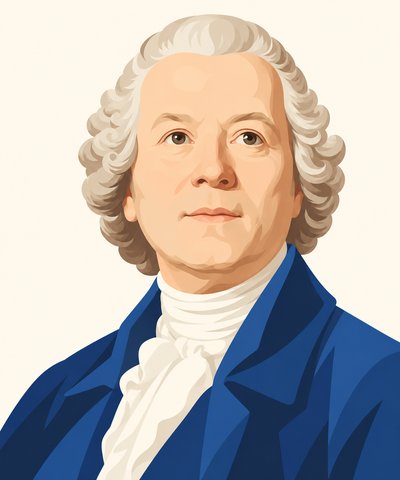
Christoph Willibald Gluck was born in 1714 in Erasbach, a village in Bavaria, in the south of Germany. His father was a forester, and so was his grandfather. When Christoph was three, the family moved to Bohemia, now the Czech Republic, where his father worked as a forester for rich princes. His father wanted Christoph to become a forester too, not a musician. So at about 14 the boy ran away to Prague. According to his own story, he paid for his food on the way by singing and playing in village churches. In Prague he sang in churches and studied at the university. At 22 he went to Milan to study, and at 27 his first opera was performed there. In 1745, at 31, he went to London. His two operas there failed. But he met Handel, who was 29 years older and the most famous composer in England. Handel is said to have joked that Gluck knew no more about the rules of music than his cook. Gluck did not mind. It is said that he kept a large portrait of Handel in his bedroom all his life and looked at it every morning.
For a few years he travelled with opera companies through Germany, Austria and Denmark. In 1750, at 36, he married Maria Anna Pergin, 18, the daughter of a rich merchant in Vienna. Her money made him independent, and the marriage was happy. He settled in Vienna and wrote music for the court. He also taught music to the children of the Empress Maria Theresa. One of them was the little princess Marie Antoinette, who later became Queen of France. In 1762, at 48, he wrote Orfeo ed Euridice with the poet Calzabigi, who was the same age. The opera tells the Greek story of Orpheus, who goes down to the land of the dead to bring back his wife. It was quite different from other operas of the time. In those operas, the singers stopped the story again and again to show off their voices with long, difficult ornaments. Gluck cut all that out. Five years later, in the preface to his next opera, he wrote that music should serve the poetry, and that he had looked for "a beautiful simplicity." These words changed the history of opera.
In 1773, at 59, he moved to Paris. His former pupil Marie Antoinette was now married to the future King of France, and she used her position to help him. His first Paris opera, Iphigénie en Aulide (1774), was a great success. Before this, the famous philosopher Rousseau had written that French was a bad language for singing, and a good opera in French was impossible. After he heard Gluck's opera, he said he had been wrong. But many people in Paris still preferred the old Italian kind of opera, where the singers showed off their voices. They brought the Italian composer Piccinni to Paris as a rival to Gluck, and for years the newspapers were full of the war between the "Gluckists" and the "Piccinnists." In 1777 Gluck wrote Armide. One air from it is On s'étonnerait moins que la saison nouvelle. He took the words from an opera that Lully had written 91 years earlier for Louis XIV and set them to new music. Armide was Gluck's favourite among his own operas. In 1779 both he and Piccinni wrote operas on the same story, Iphigénie en Tauride. Gluck's was called a masterpiece at once, and Piccinni's was not.
Gluck was proud, blunt and quick-tempered, and in rehearsals he was a terror. He ran around the orchestra, shouting at the players, and came home soaked in sweat. Yet he was popular, and he was generous to young musicians. In 1784 his young pupil Salieri wrote an opera for Paris. Salieri was not yet known there, so the public was told at first that the opera was by Gluck, and then that it was by both of them. The opera was a success. Then Gluck wrote to a newspaper and said that Salieri had written all of it. Mozart, 42 years younger, wrote proudly to his father in 1782 that Gluck had praised him and invited him to dinner. Gluck loved good wine. A German prince once had a whole barrel of Rhine wine put in his cellar in Vienna, because he had heard how much Gluck loved it. His wife managed their money well, and he became a rich man. In his sixties he had several strokes, and he retired to Vienna. It is said that one day in November 1787, when his wife left the room at lunch, he drank a glass of liqueur that his doctor had forbidden, and said to his guests, "Don't tell my wife." That afternoon he had another stroke during a carriage ride, and he died the next day in Vienna, at 73. Before Gluck, an opera was a concert for star singers. He made the story the master of the music, and every opera composer after him, from Mozart to Wagner, built on that idea.
Chanter les morceaux de Christoph Willibald Gluck
Ces morceaux sont dans Singalong Solfege. Chantez-les en solfège avec une voix guide et un accompagnement de piano.
| N° | Difficulté | Titre | Année | |
|---|---|---|---|---|
| Ex. 6-2 | ④ | On s'étonnerait moins que la saison nouvelle | 1777 |