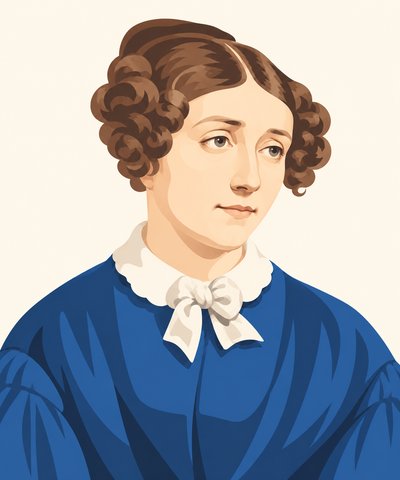
Pauline Duchambge was born in 1776 in Strasbourg, in eastern France, into a rich noble family. As a girl she went to a school run by nuns in Paris. There she had her first piano lessons. In 1789, when she was 12, the French Revolution began. By the time she was about 20, her parents had died, and the family money was gone. Around the same time she married her cousin, but the marriage was not happy, and it ended in divorce. After the divorce, she had only a small sum of money each year to live on. In 1814, when Napoleon fell from power, she lost even this money because of the political changes. She was 37. From then on she lived by teaching music and writing songs.
She knew many of the musicians of Paris. The composers Cherubini and Dussek helped her with her playing and her composing. Her songs were romances, simple songs with a beautiful melody. They were sung in the salons of Paris, the homes of rich families where people met to talk and hear music. For about twenty years her romances were among the most popular songs in Paris. She wrote hundreds of them. Ronde des pauvres (Dance of the Poor) was published around 1830.
Her closest friend was the poet Marceline Desbordes-Valmore. Duchambge set more than 50 of her poems to music, more than any other composer did. Both women were poor. They wrote to each other for the rest of their lives. Once Pauline complained that Marceline had written her name in a letter without a loving word. Marceline answered that Pauline’s name was “the wine of my poor soul.” She meant that just seeing the name gave her strength.
People who knew Duchambge said that she was gentle and full of charm, but always a little sad. She lived simply and carefully. It is said that she once said, “I composed my romances with my tears.” In her last years her health was poor, and she saw only a few close friends. She died in Paris in 1858, at 81. After her death, her friend the composer Daniel Auber took more than 300 of her songs to the library of the Paris Conservatoire, where they are kept today.
Duchambge lost her family’s money as a young woman, and she lived by her songs. Many of them were written to the poems of her closest friend. For twenty years they were among the songs that Paris loved most.
Chanter les morceaux de Pauline Duchambge
Ces morceaux sont dans Singalong Solfege. Chantez-les en solfège avec une voix guide et un accompagnement de piano.
| N° | Difficulté | Titre | Année | |
|---|---|---|---|---|
| Ex. 14-6 | ④ | Ronde des pauvres | 1830 |