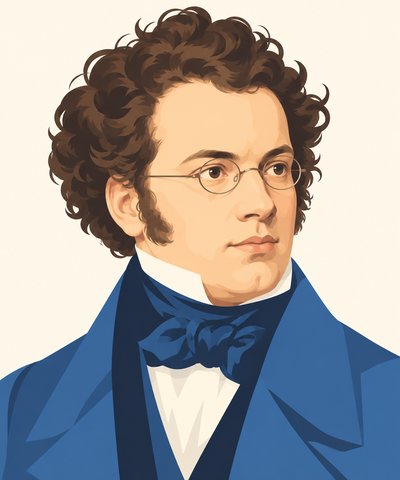
Franz Schubert was born in 1797 in Vienna. His father was a teacher, and he ran a small school in a suburb of the city. His mother had been a cook before her marriage. They had fourteen children, and only five of them lived to grow up. His father taught him the violin, and his older brother taught him the piano. The brother wrote later that after a few months the boy already played better than he did, and told him he needed no more lessons. The organist of the local church taught him singing. It is said that whenever the organist wanted to teach the boy something new, the boy already knew it.
In 1808, at 11, he became a boy singer in the choir of the emperor's church in Vienna, and he lived at a school for the choir boys. The school was cold, and the food was poor. At 15 he wrote to his brother and asked for a little money each month for a small loaf of bread and some apples, because there were eight and a half hours between a poor lunch and a poor supper. In the school orchestra an older boy named Joseph von Spaun turned round one day to see who was playing so well behind him. It was a small boy in glasses. The boy told him, blushing, that he composed all the time and would compose every day if he could pay for music paper. From then on Spaun bought the paper.
In 1812, when he was 15, his mother died. That summer his voice changed, and he could no longer sing as a boy. In the same year he began to study composition with the court composer Antonio Salieri, who taught him for about four years. At 16 he left the choir school.
In the autumn of 1814 he began to teach the youngest children at his father's school. He hated the work. His sister remembered that he was strict and quick-tempered with the children. In the same autumn his first Mass was sung in the church where he had been a choir boy, and he conducted it himself. In 1815, at 18, Schubert wrote about 140 songs in a single year. Die Mondnacht (The Moonlit Night) is one of them. Another is Erlkönig (The Erl-King), a song about a father who rides home at night with his sick son, while a spirit calls to the boy. Spaun remembered the afternoon when Erlkönig was written. He came in and found Schubert walking up and down with the poem in his hand, glowing with excitement. He sat down, and the whole song was on paper as fast as a hand can write. Schubert had no piano at home, so the friends ran with the pages to the choir school, and Erlkönig was sung there the same evening.
In 1816, when Schubert was 19, Spaun sent a volume of Schubert's songs on Goethe's poems to the great poet himself, with a letter. Goethe never answered. Jägers Abendlied (Hunter's Evening Song) is one of the Goethe songs of that year.
At the end of 1816 he left his father's school. He moved in with his friend Franz von Schober, a young man from a rich family, who paid for everything. In 1817 he wrote An die Musik (To Music) on a poem by Schober. In the same year Schober brought the singer Johann Michael Vogl to hear his songs. Vogl was a star of the court opera and 29 years older than Schubert. Schubert was so nervous that he could hardly speak. But Vogl saw his talent. Soon he sang Schubert's songs everywhere, with Schubert at the piano, and the two were together almost every day.
His friends loved his music so much that they held evenings just to hear it. They called these evenings "Schubertiades." Schubert played the piano, and Vogl or another friend sang. Often he also played waltzes for the others to dance to, sometimes for hours, but he never danced himself.
On 7 March 1821, when Schubert was 24, Vogl sang Erlkönig at a big public concert in Vienna, and the audience asked to hear it again. Until then not a single song of Schubert's had been printed. The publishers had refused to print Erlkönig, even for free, because the composer was unknown and the piano part was too hard. So his friends paid for the printing themselves. In nine months more than 800 copies were sold. After that a Vienna publisher agreed to print his songs. Soon, short of money, Schubert sold him the rights to his first twelve works for a single payment. Frühlingsglaube (Faith in Spring) is from these years.
Schubert admired Beethoven deeply. Beethoven also lived in Vienna, but the two men probably knew each other only by sight. In 1822 Schubert published a set of piano variations and dedicated them to Beethoven. On the title page he wrote that he admired and looked up to him.
At the end of 1822, at 25, Schubert became seriously ill. In February 1823 he could not leave the house, and in the summer he spent some weeks in hospital. In August he wrote to a friend, "I doubt whether I will ever be completely well again." In that same year he wrote Die schöne Müllerin (The Beautiful Miller's Daughter), a set of twenty songs that tell one story. A young miller loves the daughter of his master, loses her to a hunter, and drowns himself in the brook. It is said that he wrote some of these songs in the hospital. Der Müller und der Bach (The Miller and the Brook) is the 19th song of the set. Auf dem Wasser zu singen (To Be Sung on the Water) and Nacht und Träume (Night and Dreams) are from the same time.
In 1825, at 28, he spent five months with Vogl in the mountains of Upper Austria. Everywhere they went, Vogl sang his new songs in private houses. One of them was a song to the Virgin Mary. It is known today all over the world as Schubert's Ave Maria. He wrote in a letter that people were surprised by the deep religious feeling in the song, and that it seemed to move everyone. "I think that is because I never force myself to be religious." On the same journey he began his longest symphony, the "Great" C major Symphony.
He was poor for most of his life, and his friends often paid for him. From 1825 he, a painter and a young writer shared almost everything. Hats, coats and boots were worn in turn, and whoever had money paid for the other two. When Schubert had sold a piece of music, the three felt rich for a few days and spent it all. One evening Schubert and the writer met by chance in a coffee house, and each caught the other ordering only coffee and biscuits, because neither could pay for dinner.
In March 1827 Beethoven died, and Schubert carried a torch at his funeral. One year later, on 26 March 1828, at 31, Schubert gave a public concert of his own music, on the anniversary of Beethoven's death. It was the only one in his life. More people came than the hall had ever held, and for once he had money. Three days later the famous Italian violinist Niccolò Paganini gave his first concert in Vienna. The tickets were very expensive, but Schubert went, and he went a second time only to pay for the ticket of his writer friend, who had no money at all. In August he wrote Ständchen (Serenade).
In September 1828 he moved into his brother's new flat on the edge of Vienna, because the doctor had told him he needed fresh air. In October he and his brother walked to Haydn's grave, a day's walk from Vienna. In November he fell ill with a high fever, and he could no longer get up. In bed he still checked the printed pages of his newest songs before they went on sale. On 19 November 1828 he died in his brother's flat, at only 31. His family believed that he had wished to lie near Beethoven, so he was buried close to Beethoven's grave.
In his lifetime Schubert had no post at a court, and few orchestras played his music. Publishers wanted only songs and short pieces that people could play at home. So many of his big works were played only after his death. In the winter of 1838–39 Schumann visited Schubert's brother in Vienna, and among Schubert's papers he found the "Great" C major Symphony, which had never been performed in public. In March 1839 Mendelssohn conducted its first performance in Leipzig. The Unfinished Symphony, which Schubert had given to a friend in 1822, was found and first played only in 1865. Liszt arranged many of Schubert's songs for the piano, and he played them in his concerts all over Europe. He called Schubert "the most poetic musician who ever lived."
Schubert was shy and awkward with strangers, and warm and relaxed among friends. He cared little for money or fame. He lived for music and for his friends, and in turn his friends gave him their help and their love. He wrote more than 600 songs in a life of only 31 years, probably more than any other great composer, and about a thousand works in all. His melodies are often simple, but once you hear them, you cannot forget them. He made the song for one voice and piano as important as a symphony or an opera, and the song composers who came after him, such as Schumann and Brahms, took him as their model. He is often called the "prince of song."
Sing Franz Schubert's songs
These songs are in Singalong Solfege. Sing them in solfege with a guide vocal and piano accompaniment.
| No. | Difficulty | Title | Year | |
|---|---|---|---|---|
| Ex. 13-3 | ⑤ | Die Mondnacht | 1815 | |
| Ex. 10-3 | ③ | Jägers Abendlied | 1816 | |
| Ex. 5-4 | ② | An die Musik | 1817 | |
| Ex. 8-5 | ③ | Frühlingsglaube | 1822 | |
| Ex. 8-6 | ⑤ | Auf dem Wasser zu singen | 1823 | |
| Ex. 11-3 | ① | Free | Nacht und Träume | 1823 |
| Ex. 14-4 | ③ | Der Müller und der Bach | 1823 | |
| Ex. 2-5 | ③ | Ständchen | 1828 |