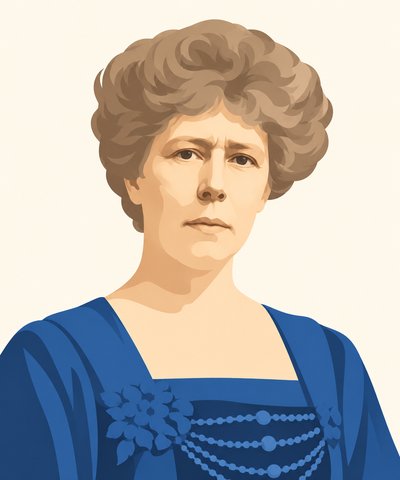
Carrie Jacobs-Bond was born in 1862 in Janesville, a small town in Wisconsin, in the American Midwest. Her father was a doctor, and she was an only child. As a little girl she could play almost anything by ear. When she was eight, a famous blind pianist gave a concert in her town. He could play any piece after hearing it once. Someone in the audience called out that there was a little girl there who could do the same. Her father led her to the stage. The pianist played a march, and she played it back to him. “My father was very proud,” she later wrote. A few years later her father lost all his money, and soon afterwards he died. She never had lessons in how to write music.
At 18 she married, but the marriage did not last. A few years later she married Frank Bond, a doctor she had known since she was a girl. They lived in a small mining town in northern Michigan, and she called those years the happiest of her life. He encouraged her to write down the little songs that ran through her head. Then the mines closed, and his patients could no longer pay him. So she decided to sell her songs. Soon afterwards, in 1895, Frank Bond died after a fall on the ice. She was 33, and her son from her first marriage was 13.
She moved to Chicago with her son. She rented out rooms, painted pictures on plates and cups to sell, and sold her furniture piece by piece, but she kept her piano. Often she ate only one meal a day. Even so, every winter she let someone poorer than herself sleep in her back room. Someone told her to sing her songs on a stage, to sell them. At a cheap theatre the audience hissed. She ran home crying, and her son ran after her and said, “Mother, it was just wonderful!”
Then she did something brave. From a shop on the corner, she telephoned the famous singer Jessie Bartlett Davis, whom she had never met, and asked her to listen to her songs. Davis agreed. When she heard them, she said, “You must have those published at once, and I am going to sing them!” The printing cost 500 dollars. Bond had saved 250, and Davis gave her the other half. In 1901 her first book of songs came out. She painted the cover herself, with wild roses, and called them “songs as unpretentious as the wild rose,” meaning simple and not grand. She later wrote that she chose those words because she was afraid of the critics. With her son she started a small company to publish her songs. The Angelus came out in 1904 in another book with the same wild-rose title.
One song from her first book, I Love You Truly, became a favourite song at American weddings. She was the first woman to sell a million copies of a song. In 1907, at 45, she sang for President Theodore Roosevelt at the White House. Her song A Perfect Day (1910) sold millions of copies. During the First World War, thousands of soldiers in army camps sang it with her. She wrote that then she was glad to be a writer of home songs, rather than a great musician. She died in Hollywood in 1946, at 84.
Carrie Jacobs-Bond never learned how to write music, and she began her career only because she had to support her son. Her simple songs were sung by millions of people, at weddings, in homes and in army camps.
Sing Carrie Jacobs-Bond's songs
These songs are in Singalong Solfege. Sing them in solfege with a guide vocal and piano accompaniment.
| No. | Difficulty | Title | Year | |
|---|---|---|---|---|
| Ex. 6-14 | ③ | The Angelus | 1904 |