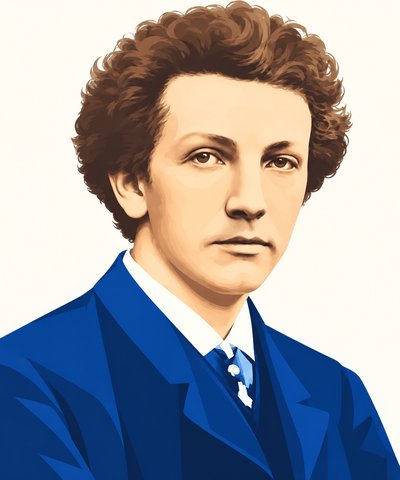
Richard Strauss was born in 1864 in Munich. His father was the first horn player of the court orchestra in Munich. He loved Mozart and Beethoven, and he hated the music of Wagner. Richard began composing at six. He never went to a conservatory, and he learned how to write music from his father's musician friends. At 21 he became assistant conductor of the orchestra in Meiningen, a small town in central Germany. There Brahms heard him conduct his own first symphony. Brahms, then 52, told the young man that he put too many ideas into his music. He advised him to look at Schubert's short, simple waltzes and learn to write a plain, good melody first. Strauss remembered this advice all his life. In Meiningen an older friend also showed him the music of Wagner and Liszt. His father had kept him away from it, but now Strauss fell in love with it.
Between 1889 and 1898 he wrote the works that made him famous. They are tone poems, pieces for orchestra that tell a story without words. The best known is Also sprach Zarathustra (Thus Spoke Zarathustra). Its opening, with the sunrise on the trumpets, is known to millions from the film 2001: A Space Odyssey. In 1894 Strauss married the soprano Pauline de Ahna, who had been his pupil. She had a sharp tongue, and she is said to have thrown a score at him during a rehearsal. But they stayed married for 53 years, and he wrote many of his songs for her voice. Then came the operas. Salome in 1905 shocked audiences. Der Rosenkavalier (The Knight of the Rose) in 1911 charmed them, and it is still his most loved work. He was also one of the leading conductors of his time, in Berlin and later in Vienna. Mahler, four years older, was his friend and his rival. Mahler called Salome "a work of genius." Mahler once wrote that he and Strauss were like two miners digging a tunnel from opposite sides of the same mountain, and that one day they would meet in the middle.
His years under the Nazi government are still debated today. For two years he held an official post as head of the state music office. He lost it when the police found a private letter in which he wrote that he did not believe in the Nazis' ideas about art. He also used his position to protect his son's Jewish wife and his grandchildren. In 1945, at the end of the Second World War, American soldiers came to his house in Garmisch, in the mountains of Bavaria. The 80-year-old composer met them at the door and said, "I am Richard Strauss, the composer of Rosenkavalier and Salome." The soldiers put up a sign to protect the house and left him in peace. At 84 he wrote his Four Last Songs, for soprano and orchestra. They are among the most beautiful farewells in music. He died in Garmisch in 1949, at 85. Pauline, his wife of 53 years, died eight months later. He was the last of the great Romantic composers and a master of writing for the orchestra. He also founded the first society in Germany that collected fees for composers whenever their music was performed.
Lieder von Richard Strauss singen
Diese Lieder sind in Singalong Solfege enthalten. Singen Sie sie in Solmisation mit Führungsstimme und Klavierbegleitung.
| Nr. | Schwierigkeit | Titel | Jahr | |
|---|---|---|---|---|
| Ex. 5-10 | ② | Die Nacht | 1885 |