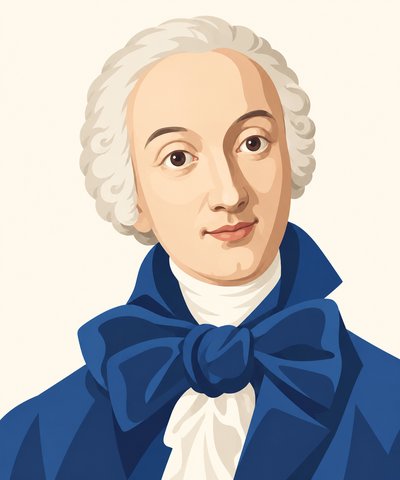
Luigi Boccherini was born in 1743 in Lucca, a small independent state in central Italy. His father played the cello and the double bass, and his brothers and sisters became dancers and singers. His father gave him his first cello lessons when he was about five. As a boy he was sent to Rome to study with a famous cellist. At 13 he played a cello concerto in public in Lucca. The music director of the cathedral there, Giacomo Puccini, an ancestor of the opera composer, encouraged him. At 14 he and his father joined the orchestra of the court theatre in Vienna. The music there was directed by Gluck, so Boccherini played Gluck’s music in the orchestra. Years later, in his symphony The House of the Devil (1771), he put in the music of a wild dance from one of Gluck’s ballets.
In 1768, at 25, he went to Spain with a violinist friend, and he stayed there for the rest of his life. It is said that he went with an Italian opera company because he was in love with its soprano, Clementina Pelliccia. They married in 1769, and they had six children. In 1770 Don Luis, the younger brother of the King of Spain, made him his cellist and composer. In 1776 Don Luis married a woman who was not of royal rank. Because of this, he had to leave the court, and he moved to a small town in the mountains west of Madrid. Boccherini and the other musicians went with him. There he wrote a huge amount of music. Cujus animam gementem comes from his Stabat Mater. He first wrote it there in 1781.
In 1785 his wife died, and a few months later Don Luis died too. Boccherini was left with six young children. In Madrid he worked for rich noble families. In 1787 he married again. In 1800 Lucien Bonaparte, the brother of Napoleon, came to Madrid as the French ambassador and became his supporter. For him Boccherini made a new version of the Stabat Mater for three voices.
As a leader he wanted music to be played softly and smoothly. When someone played too loudly, he would call out, “Oil, my friend, oil!” One day a young French violinist, Alexandre Boucher, asked to play one of his quintets. Boccherini said that he was too young and did not yet have the right style. Boucher would not give up. After about twelve bars Boccherini took the music away. Boucher then asked him to teach him how to play it, and Boccherini gladly agreed. He was proud of always keeping his word. It is said that he once refused a much larger sum for his Stabat Mater, because he had already promised it to a publisher in Paris for less.
He died in Madrid in May 1805, at 62.
Boccherini was a cellist, and he wrote music for his own instrument and his own small group of players. He wrote more than 100 quintets with two cellos, so that he could play one of the cello parts himself. He gave the cello a singing voice. A French violinist of his time is said to have written that if God wanted to speak to people, he would use the music of Haydn. But if God wanted to listen to music himself, he would choose Boccherini.
Lieder von Luigi Boccherini singen
Diese Lieder sind in Singalong Solfege enthalten. Singen Sie sie in Solmisation mit Führungsstimme und Klavierbegleitung.
| Nr. | Schwierigkeit | Titel | Jahr | |
|---|---|---|---|---|
| Ex. 8-4 | ⑤ | Cujus animam gementem | 1801 |